

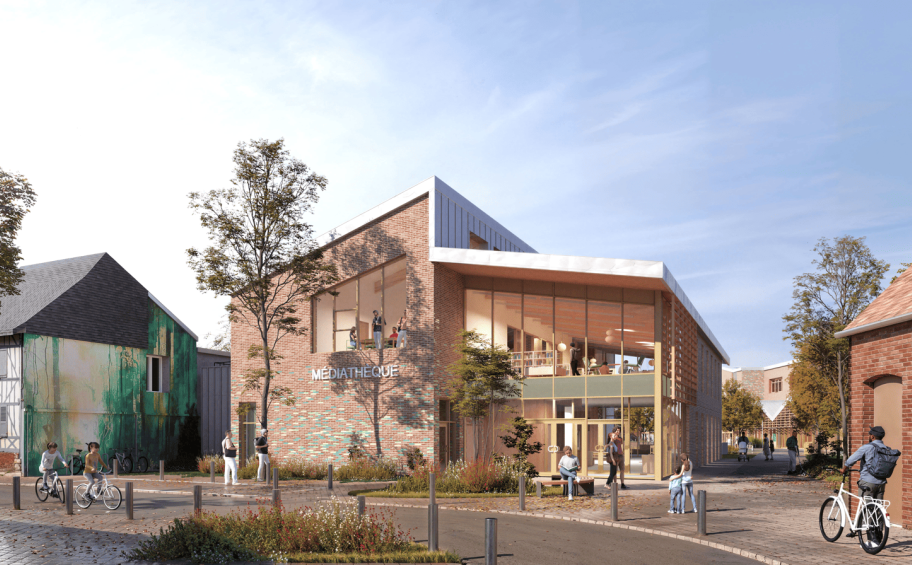


This project is also the first launched under the aegis of the Urban Planning Construction Architecture Plan (PUCA) for a community in Hauts-de-France.
Its unique feature? Designing a truly integrated ecosystem, where soft mobility, biodiversity, local shops, user comfort and urban dynamics interact harmoniously.
An operation conceived as a sustainable and meaningful project, serving the entire metropolitan area and the attractiveness of the city centre.
Following a land recycling strategy, the buildings are being constructed on the former site of the old school. The future complex will house a cultural hub including a multi-purpose hall, spaces for associations, a coworking space, a performance hall, a media library, and an auditorium. It will be able to accommodate up to 1,500 people.
Beyond the buildings, and in keeping with the PUCA's interactive territorial modeling approach (BIM CIM TIM), the project redesigns the surrounding area and strengthens the connection with the city center. Forecourts, pedestrian walkways, an outdoor esplanade, and landscaped spaces all contribute to creating a new, open, and welcoming central hub.
The environmental approach is a key pillar of the project. The media library was designed according to bioclimatic principles in order to optimize natural light, solar gain in winter and protection against overheating in summer.
Orientation of volumes, skylights in the roof, solar protections, natural ventilation and limiting the use of artificial lighting all contribute to ensuring lasting thermal comfort.
With this view of modelling the territory and with a view to energy solidarity, photovoltaic production will promote self-consumption and will also supply all buildings belonging to the community ; in an additional phase of work, a heat network could also be created.
The project aims for performance that complies with the requirements of RE2020.
Outdoor spaces also play an important role in the project: meadows under differentiated management, a biodiversity garden, conservation of existing trees and the creation of a shrubby border to preserve the privacy of local residents.
Stormwater management is ensured through landscaping features such as a rain garden and drainage surfaces, promoting natural infiltration and limiting runoff.
Ecologists from Eiffage Construction were involved from the competition response phase and are also involved in the PRO phase in order to integrate the issues of biodiversity and ecological continuity into the project from the outset.
The schedule includes 10 months of studies and 21 months of work, with construction scheduled to begin in 2027.
Well done to our teams for this new sustainable project!
Project owner: City of Crèvecœur le Grand - ETYO
Architect: MURMUR ARCHITECTURE
Landscape architect: Espace Libre
Joint contractors: Eiffage Energie Systèmes / Eiffage Route
BET: ESER / BâtiTech / Leslie Acoustique / Alteco / TRACKS
