

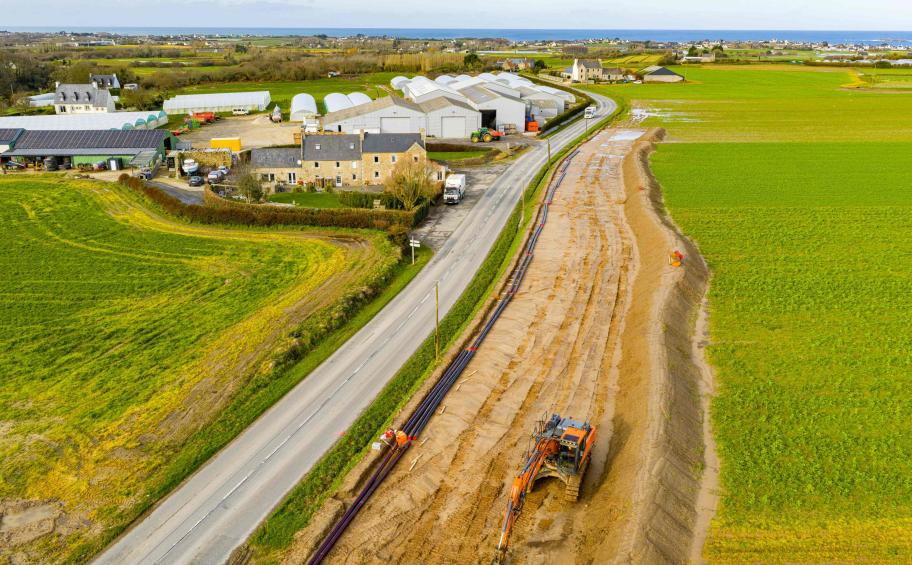


The double submarine cable carrying 320 kV over two 500-km sections includes an underground land section at each end: 40 km (x 2) in Brittany and 35 km (x 2) across County Cork, Ireland. This 575 km-long high-voltage direct current (HVDC) link aims to interconnect the Irish and French electricity grids to secure the electricity supply at European level.
Work on the RTE underground link (on the French side), led jointly by several teams from the Energy Systems division, is currently underway. Eiffage Génie Civil and Eiffage Fondations have been tasked with drilling a microtunnel beneath the Paris-Brest high-speed rail line (LGV) and beneath the Élorn, a coastal river in Finistère flowing into Brest harbour. Meanwhile, our specialists are digging 65 cm-wide trenches from the beach to install the sheaths for the world’s longest XLPE (cross-linked polyethylene) cable.
The total length of the land-based link, stretching from the landing station (15 metres long, 4 metres wide and 3 metres deep) in Cléder, northern Finistère, to La Martyre substation, where the AC/DC conversion station is located, is around 40 kilometres. “Our teams are constructing the first 21 kilometres, from the landing chamber to junction no. 15, and the second section of the underground link is being built by DLE Ouest, from junction no. 17 to the conversion station, located beyond junction no. 28. We are also building some junction chambers,” said Eiffage Énergie Systèmes - Réseaux & Solutions project manager Hervé Burel. “For this project, we have set up a mobile welding workshop supplied by battery-powered generators (which are quieter), and all our machinery runs on biofuel. Our decarbonisation rate has fallen significantly (-80% in July 2025), and is already ahead of the Eiffage Group’s 2030 low-carbon target,” he continued.
At the client’s request, an ecologist specialising in the protection of endangered animal species (amphibians, Quimper snails, etc.) was tasked with inspecting each area before work began so that protected individuals could be relocated. Our teams were also trained in best practice regarding invasive plant species, and a number of environmental measures were put in place on this site.
Alongside the mechanised conduit installation, Eiffage Énergie Systèmes - Île-de-France (lead contractor for the Eiffage GCE consortium) and Transport & Distribution have begun laying the 80 km of 320 kV HVDC cables supplied by Nexans. “To connect Knockraha substation (in the south of Ireland) to La Martyre substation, located near Landerneau, we are installing, in sections, a module comprising two power cables (225 mm in diameter), three fibre-optic cables and two spare cables,” explained EES project manager Vincent Morice. “Our cable drums contain between 1.3 km and 1.5 km of cable. We lay the first cable in the first conduit and the second in the twin conduit. Our client, cable manufacturer Nexans, then takes charge of the assembly work, that is to say, the connections between the cable sections in the various junction chambers,” explained Vincent Morice.
At La Martyre conversion station, our experts were also tasked with linking the interconnector to the existing RTE substation, installing a 400,000-volt power line over 600 metres to convert direct current into alternating current before feeding it into the French grid.
The Celtic Interconnector will have a capacity of 700 MW, and is scheduled to go into service at the end of 2026. Ultimately, this project of European interest will supply electricity to 450,000 households and support the development of a low-carbon electricity mix in Ireland and France.
