

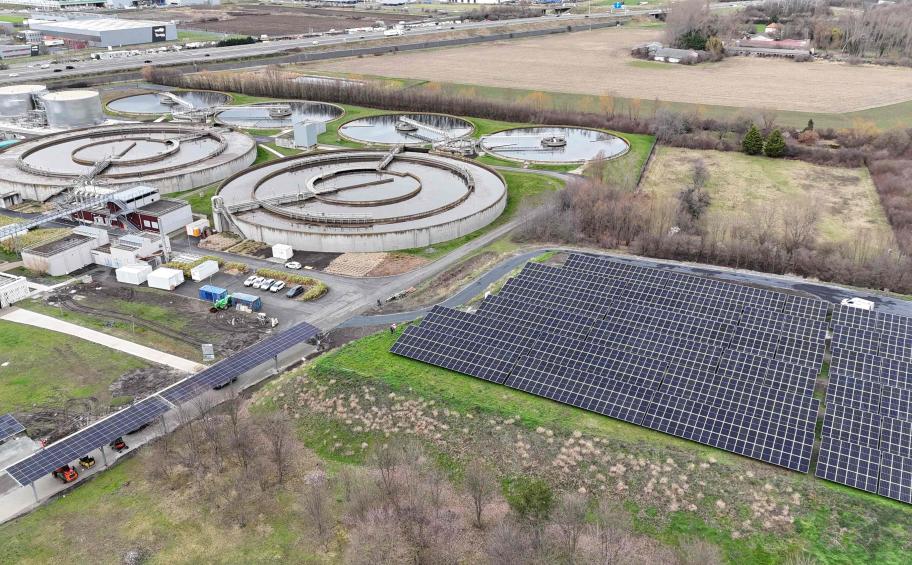


The solar power plant at Clérmont-Ferrand’s wastewater treatment facility (Puy-de-Dôme), has a capacity of 802.3 kWp and is entirely dedicated to the site’s own consumption. Its 1,353 solar panels spread across a 5,000 m² ground-mounted array, and 500 m² of shading structures covering a car park, provide between 10 and 15 per cent of the plant’s energy requirements. “This project is part of a wider initiative to optimise resources and industrial performance,” pointed out project manager Antoine Ballet.
A range of technical challenges
The project required a wide range of expertise. Our teams carried out preliminary design work, earthworks, roadworks, utility networks and foundations, as well as the installation of steel structures and solar panels. They also handled the power plant's cabling, connected the inverters and integrated the system into the factory's electrical network, including the construction of a high-voltage substation. “Our teams’ complementary expertise was a key factor in successfully meeting this challenge,” explained Antoine Ballet.
Smart energy management
One of the project’s key challenges was managing the energy generated. A ‘zero-injection’ control loop was implemented, along with a remote decoupling system, to prevent any electricity from being fed into the public grid and to ensure maximum self-sufficiency. The decoupling system is activated at Enedis’s request or when the generators start up. The power plant has been integrated into the existing industrial monitoring system, enabling centralised operation.
This solar PV power plant is the result of close collaboration between Eiffage Énergie Systèmes (lead contractor), NGE (joint contractor), and several other parties: Clermont Auvergne Métropole (project owner), SPL Clermont Auvergne (delegated project owner) and Artelia (project manager). It positions Clermont-Ferrand wastewater treatment facility as a model for energy transition and the integration of renewable energy into industrial infrastructure.
