



The APRR group has a long history of providing digital services to its customers.
Today, APRR and its subsidiary serving the Rhônes-Alpes region, AREA, are digitising the operation and maintenance of the motorway network, their core business. Launched at the end of 2016, the aim of the digital transformation project known as Numa is to provide the monitoring, maintenance and traffic control agents with tablets and smartphones equipped with business applications. These technologies do not change the operational processes, but make the day-to-day work easier.
At present, if there is a problem on the motorway network, staff have to fill out paper forms, make phone calls, take pictures... These multiple media are a constraint for them but also for those who have to process the information in real time and at a later date. By 2018, safety and toll maintenance agents should all be equipped with a mobile application that will transmit information in real time, making it easier to collect data in the field and simplifying the use of the data.
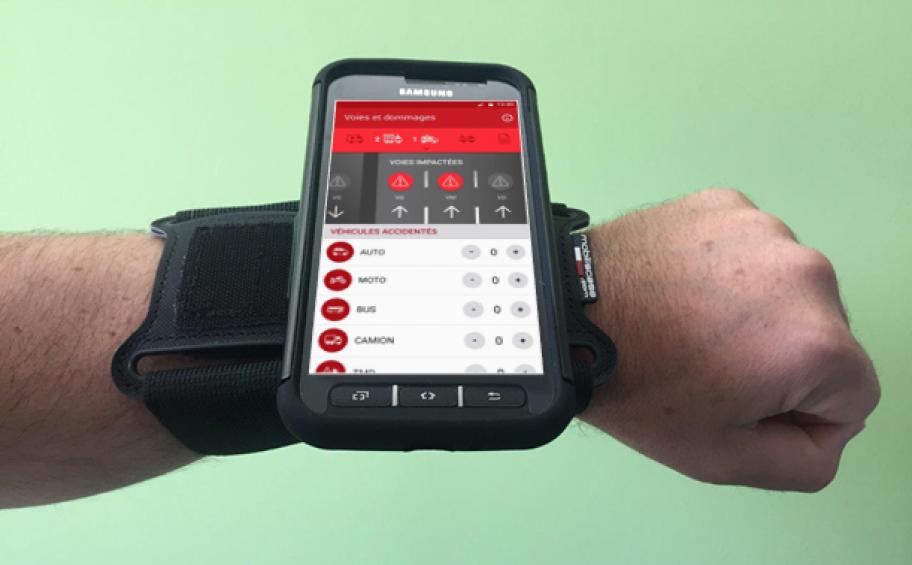
An accident management app
The accident management application meets a practical need: to integrate a mobile phone, a camera and paper files into a single tool. It will allow real-time capture of data - such as the time of arrival/departure of external service providers - as well as more general information (damage, circumstances, etc.). Smartphones with around six-inch screens have been chosen for this purpose. Each team leader will have his/her own identification. The attachment system will be individual, either a strap or a belt clip. Rollout on each site is scheduled for January 2018.
The bottom line is the time gained, which in the case of an accident, for example, could be reinvested in the core competencies: management of the event, accident analysis and the corrective and preventive actions to be taken.
Getting rid of a binder weighing 4 kg!
Numa will also improve the day-to-day work of the toll technical maintenance agents by reducing the paperwork and the amount of data. It will also optimise preventive maintenance. The agent goes on site, connects to his smartphone or tablet, accesses the operating modes with the latest updated version (thus getting rid of a binder weighing nearly 4 kg), his schedule for the day and the various instructions left by his colleagues, to which he can then add his own. The agent has a global view of the activity per site, allowing him to anticipate certain tasks. He is therefore more autonomous and more efficient in his work.
Numa: a revolution on the move
Numa is a cultural and human revolution just as much as a digital one. It is an innovative method that puts the end user at the heart of the process and offers a brand new experience. Users are in fact involved at each implementation stage, in order to create customised tools. As from the beginning of November 2017 and for two months, staff at ten pilot sites will be testing the two new applications (accident chain management and toll technical interventions).
This phase will enable final adjustments to be made and will prepare for industrialisation (hotline, support and training) planned for 2018.
New applications will also be developed, designed and tested using the same approach in other business areas as of next year.
