

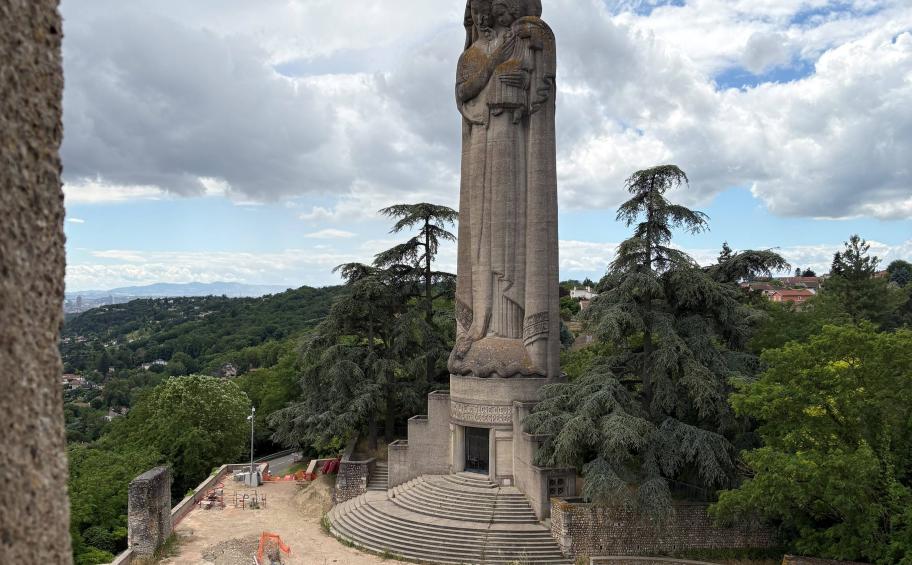


This contract, awarded in the summer of 2025, forms part of the extensive renovation programme for the Madone de Miribel site. The 33-metre-high reinforced concrete statue, built between 1938 and 1941 with donations from local residents, is flanked by a 28-metre-high stone bell tower, erected in 1946. The tower houses around fifty bells delivered in the middle of the Second World War, including a bourdon (bass bell) weighing over two tonnes. The site, long left derelict after the diocese’s withdrawal, was subsequently closed for safety reasons. It has now been revitalised thanks to a crowdfunding campaign, symbolically echoing its original construction.
“The contract awarded to our consortium specifically covers the lighting of the esplanade and the site’s two iconic buildings. The approach combines functional lighting with the enhancement of the site’s heritage,” explained branch manager Laura Froppier. The staircase leading up to the Esplanade de la Madone and the balustrades of this terraced area will be fitted with 150 micro-projectors built into the handrails to ensure safe passage without adding any unnecessary lighting elements. The Madonna will be enhanced by video mapping, designed and programmed by a company specialising in projection onto sculpted surfaces.
With a track record including projects like the Hôtel-Dieu and the Lycée Saint-Just in Lyon, our specialist team, led by business manager Fouad Kawaf, will be responsible for architectural lighting across the whole site. “The esplanade is to be fitted with around twenty street lamps and the same number of spotlights, which we will use in particular to illuminate a pergola. We will also install nearly 30 linear metres of LED lighting beneath the bench seats,” added Laura Froppier. The lighting for the carillon will be designed primarily from within the openwork building, so as to better reveal its structure and highlight the bourdon using a system of LED tubes, supplemented by a few external spotlights. The whole site was listed as a historic monument in 2020 (the carillon bells having been listed since 1993). It therefore requires close monitoring in collaboration with the DRAC and the ABF (Architectes des Bâtiments de France) at every stage of the project.
This iconic monument, visible for kilometres around, is closed to the public during the renovation work. It will be reopened in early 2028.
