

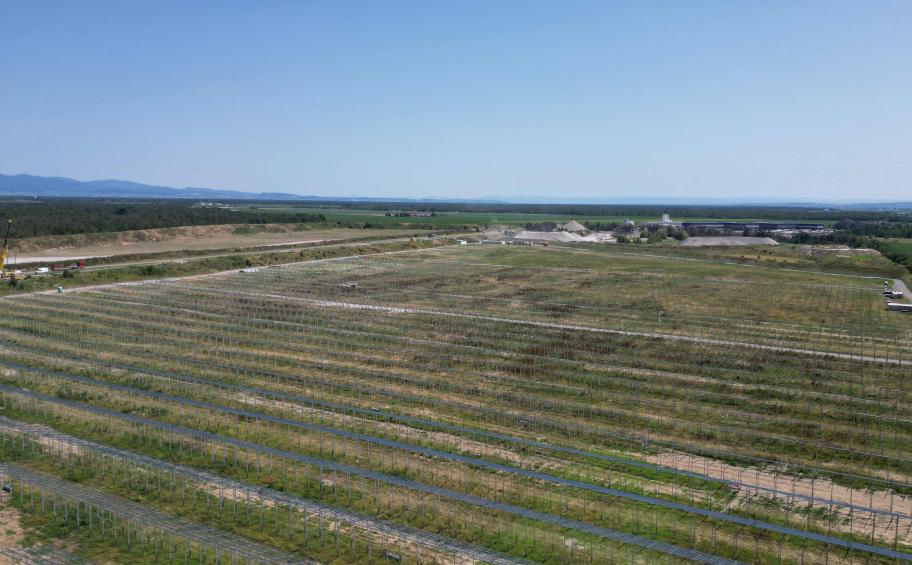


As the developer and investor behind this PV project, Tryba Energy was tasked with finding a suitable site and setting up a long-term lease, granting it management rights over the land for a very long period (minimum 30 years), before launching preliminary studies (soil surveys, environmental impact assessments, public inquiries, permit applications, building approval, etc.). "Once finalised, the Réguisheim ground-mounted PV power plant project was submitted to the Energy Regulatory Commission by the developer. The EPV1 project won the tender and was subject to an EPC. In other words, Tryba Energy awarded us the contract to build the turnkey plant and supplied us with the modules," said PV project manager Thierry Adloff.
The project team entrusted a specialist structural engineer with installing the metal structures and fitting and connecting the modules. It also oversaw road construction, fencing and trenching for cable routing. "To be able to deliver high-voltage current (20,000 V), the power station cannot exceed a certain power level. That is why we built two complementary power plants, side by side: 20.2 MWp for the southern section and 3.2 MWp for the northern section, for a total of 23.4 MWp. We purchased two combined delivery and transformer substations, each connected to a different Enedis substation, and four transformer substations for the southern section of the power plant," explained Thierry Adloff..
The modules are connected in series in batches of 27 units to an inverter, which converts direct current (1,500 V) into alternating current (800 V). The plant's 59 inverters (51 for the south section and 8 for the north section) are wired in three-phase alternating current to the transformer substations (or combined delivery and transformer substations), then connected to a large 800 V alternating current busbar. At each transformer output, the 20,000V AC current is sent to MV cells, which enable the electricity produced by the power station to be fed into the Enedis grid. "On this type of project, the electrical work is under control, unlike the terrain, which always surprises us! Here, the power station is installed on 10,000 driven piles, sunk 2 m or 2.5 m deep into the bottom of a gravel pit. This land is potentially floodable in the event of hundred-year high water levels in the Rhine, so all electrical equipment had to be installed at height. Some structural columns rise 6 metres above the ground, but all the modules are perfectly aligned," continued Thierry Adloff.
The power plant construction site was covered by a protected species destruction order requiring compensatory measures to be put in place. The facility covers only 23 hectares of the 40-hectare site, with the remaining 17 hectares devoted to ecological compensation, such as the creation of a dozen hibernacula for reptiles and amphibians, and nesting boxes. “We have also created two platforms, each measuring 5,000 m², for the stone curlew, a wading bird that breeds on bare gravel. We have restored the grassland and are going to clear some copses to promote biodiversity,” said Thierry Adloff. Invasive species (Japanese knotweed and black locust) have been the subject of particular vigilance.
This ground-mounted PV power plant project, which combines environmental challenges with complex technical hurdles, will help to cement Clemessy's position as a key player in energy transition across the Grand Est region.
